Why Job Seekers Ignore the Best Advice - Until They Need It

If you spend enough time talking to experienced recruiters, hiring managers, or career coaches, you'll notice something interesting: the same advice comes up again and again.
Update your LinkedIn before you need it.
Build relationships before you're unemployed.
Tailor your resume.
Prepare for interviews.
Yet many professionals dismiss these recommendations—not because they're wrong, but because they don't feel relevant at the time.
Ironically, by the time they do, the opportunity to prepare has often passed.
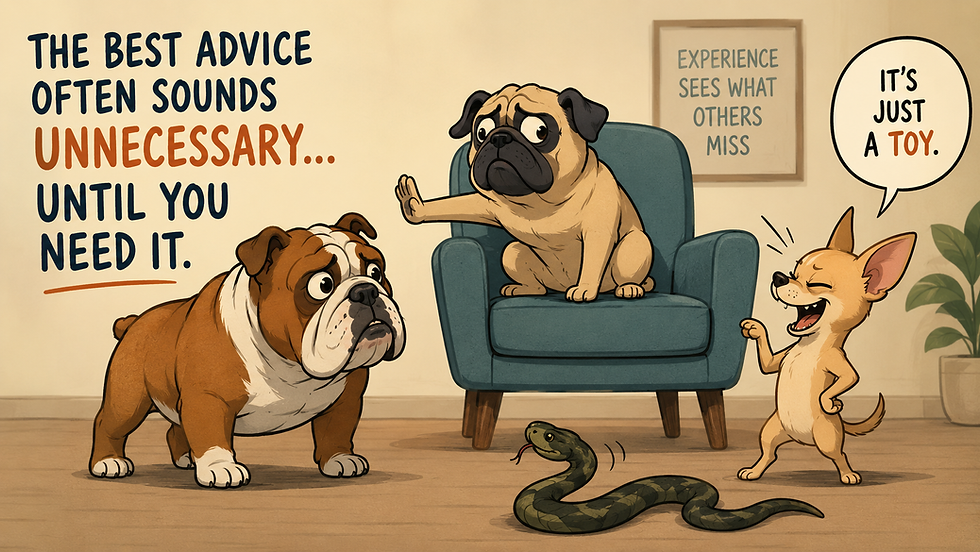
Experience Changes How We Evaluate Advice
Behavioral research shows that people consistently underestimate future risks when they haven't experienced them personally. This phenomenon, often associated with the availability heuristic and optimism bias, causes individuals to believe that negative events are less likely to happen to them than to others (Tversky & Kahneman, 1974; Sharot, 2011).
In a career context, this often sounds like:
"I already have a stable job."
"Recruiters contact me anyway."
"I'll update my resume if I ever need to."
The advice isn't ignored because it's poor.
It's ignored because the problem hasn't become real yet.
Career Advice Often Looks Unnecessary - Until Circumstances Change
Labor markets can change quickly.
Organizations restructure.
Budgets freeze.
New technologies reshape hiring expectations.
Skills that were in high demand yesterday may become baseline expectations tomorrow. Reports from the World Economic Forum consistently highlight how rapidly required workplace skills evolve across industries (World Economic Forum, 2025).
Professionals who invested in their personal brand, network, and career assets before these changes generally adapt faster than those starting from scratch.
Preparation rarely feels urgent until it suddenly becomes essential.
Why We Trust Experience Only After It Becomes Our Own
Psychologists refer to this tendency as experiential learning bias—people often assign greater value to lessons they've experienced firsthand than to information provided by others (Kolb, 1984).
Unfortunately, careers don't always offer inexpensive lessons.
Ignoring advice about networking may cost months of job searching.
Ignoring resume quality may result in missed interviews.
Ignoring interview preparation may mean losing opportunities that never return.
Some lessons become far more expensive than the effort required to prevent them.
The Best Career Advice Is Usually Preventive
Many career activities don't produce immediate results.
Networking conversations rarely generate offers overnight.
LinkedIn optimization doesn't guarantee recruiter messages tomorrow.
Building credibility through content takes time.
However, these actions create career resilience-the ability to respond effectively when circumstances change (Savickas, 1997).
Just as companies invest in risk management before a crisis occurs, professionals should invest in career management before they urgently need a new opportunity.
Practical Takeaways
Rather than waiting for a career transition, consider treating career maintenance as an ongoing habit:
Review your LinkedIn profile every few months.
Update your resume after significant achievements—not only before applying.
Build genuine professional relationships even when you're not job searching.
Ask experienced professionals why they recommend certain practices before dismissing them.
Assume that future opportunities will reward preparation more than urgency.
Small, consistent actions are significantly easier than rebuilding your professional presence under pressure.
How I Help Professionals Prepare Before They Have To
My work focuses on helping professionals build a strong career foundation before they find themselves reacting to unexpected changes.
Together, we develop a clear professional positioning strategy, optimize resumes and LinkedIn profiles, identify transferable strengths, create practical networking strategies, and prepare for interviews with confidence. The objective isn't simply to secure the next position—it's to build long-term career resilience that supports future opportunities as well.
References
Kahneman, D., & Tversky, A. (1974). Judgment under Uncertainty: Heuristics and Biases. Science, 185(4157), 1124–1131.
Kolb, D. A. (1984). Experiential Learning: Experience as the Source of Learning and Development. Prentice Hall.
Savickas, M. L. (1997). Career Adaptability: An Integrative Construct for Life-Span, Life-Space Theory. Career Development Quarterly, 45(3), 247–259.
Sharot, T. (2011). The Optimism Bias. Pantheon Books.
World Economic Forum. (2025). The Future of Jobs Report 2025.
Brown, D., & Lent, R. W. (Eds.). (2021). Career Development and Counseling: Putting Theory and Research to Work (3rd ed.). Wiley.


Comments