When Visibility Shapes Behavior: Personal Branding, Imitation, and Career Signaling in the Digital Age

A short video of a dog imitating a belly dancer on TV may look amusing, but it captures a powerful professional reality: we learn by observing what stands out. In modern workplaces and digital platforms like LinkedIn, visibility doesn’t just attract attention — it shapes behavior, expectations, and even professional identity.
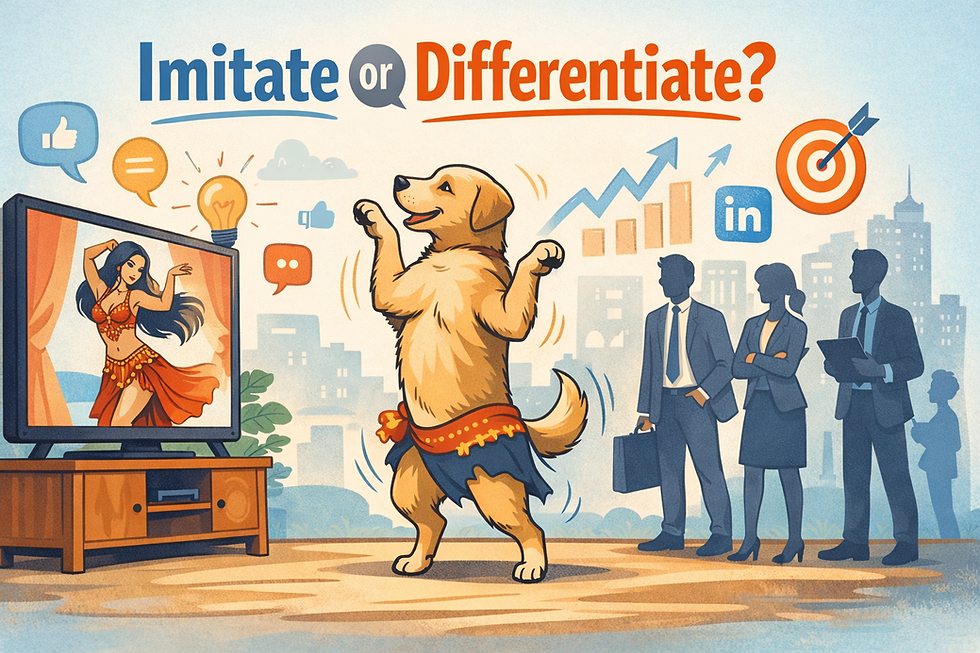
Personal Branding as Social Learning
In organizational psychology and sociology, learning through observation is a well-documented phenomenon. According to Social Learning Theory, individuals adopt behaviors they see modeled by others, especially when those behaviors appear successful or rewarded.
In professional environments, this means employees and job seekers constantly scan their surroundings for cues: how leaders communicate, how professionals present themselves, and what “success” looks like.
On platforms like LinkedIn, this process accelerates. People don’t just read content — they internalize patterns:
how authority is expressed,
how career stories are framed,
how expertise is signaled.
Over time, these visible patterns shape how professionals think they should behave.
Visibility Creates Norms - Not Just Attention
Personal branding is often framed as a marketing exercise. In reality, it functions as a norm-setting mechanism.
Research in impression management and signaling theory shows that visible professional behaviors influence what others perceive as credible, competent, and legitimate. When certain profiles dominate the conversation - those who publish insights, share frameworks, and communicate clearly - they implicitly define the “standard professional.”
This leads to three effects:
Behavioral alignment – professionals mirror communication styles they see rewarded.
Expectation shaping – hiring managers develop mental models of what “strong candidates” look like.
Identity formation – individuals start performing roles based on what is visible and validated.
Visibility, therefore, is not neutral. It actively constructs professional reality.
The LinkedIn Effect: Influence Through Presence
Digital environments intensify imitation because they make success observable and repeatable. Profiles with consistent messaging, structured thinking, and visible expertise become reference points. Others begin to replicate:
posting styles,
storytelling formats,
authority signals,
even language and terminology.
This is not necessarily negative. It helps professionals learn faster and enter conversations. But it also creates risk: imitation without strategy can lead to sameness, diluted identity, and superficial positioning.
True personal branding emerges not from copying what works — but from understanding why it works and adapting it authentically.
From Imitation to Differentiation
Imitation is often the first stage of professional development. Mastery comes from differentiation.
Career research suggests that individuals who intentionally craft their professional narrative — aligning skills, values, and visibility — achieve stronger career mobility and credibility. This is because they move from reactive signaling (“looking professional”) to strategic positioning (“being recognized for something specific”).
In other words:
imitation creates entry,
Differentiation creates authority.
A Practical Perspective for Career and Leadership
For job seekers, personal branding affects how opportunities appear and who notices them. For employees, it influences influence, promotion, and internal visibility. For leaders, it shapes culture because what leaders model becomes what teams replicate.
The question is not whether visibility matters. It is the kind of visibility professionals choose to create, intentional or accidental.
Where I Come In
In my work with professionals, job seekers, and organizations, I focus on translating experience into a visible professional identity. This includes LinkedIn positioning, career storytelling, and strategic communication that reflects real expertise rather than generic “personal branding.”
The goal isn’t to imitate what works for others but to build a presence that signals credibility, clarity, and direction, attracting the right opportunities and conversations.
References
Bandura, A. (1977). Social Learning Theory. Prentice Hall.
Goffman, E. (1959). The Presentation of Self in Everyday Life. Doubleday.
Spence, M. (1973). Job market signaling. Quarterly Journal of Economics, 87(3), 355–374.
Ibarra, H. (1999). Provisional selves: Experimenting with image and identity in professional adaptation. Administrative Science Quarterly, 44(4), 764–791.
Kreiner, G. E., Hollensbe, E. C., & Sheep, M. L. (2006). Where is the “me” among the “we”? Identity work and the search for optimal balance. Academy of Management Journal, 49(5), 1031–1057.


Comments