Automation Can Move Your Job Search. It Can't Direct It.
- Or Bar Cohen
- Jun 28
- 3 min read

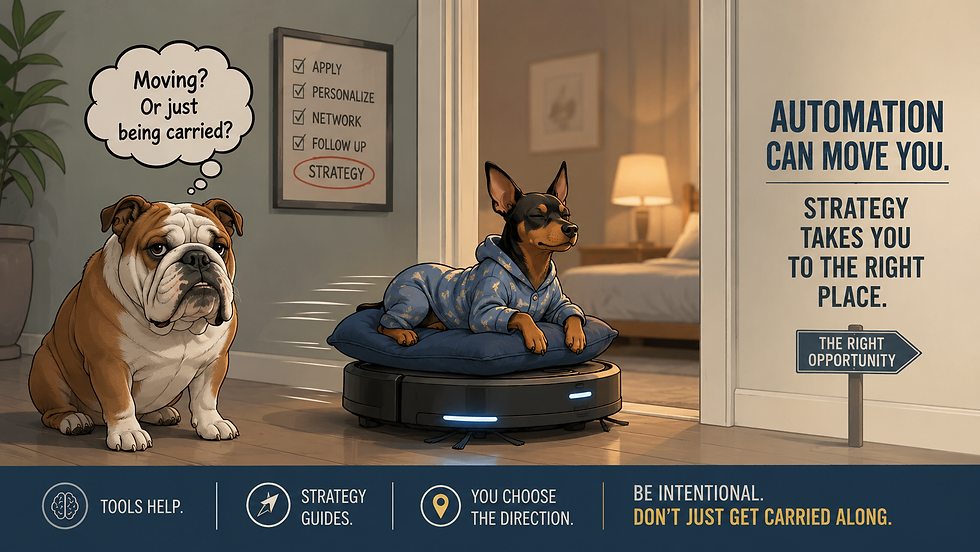
I recently watched a funny video of a small dog lying comfortably on a robot vacuum while it quietly carried him into another room. A bulldog watched the whole scene without reacting, almost as if to say, "Well... there he goes."
It was amusing, but it also reminded me of something I see more frequently in today's job market.
Many job seekers are moving faster than ever before thanks to automation. The real question is whether they're actually moving in the right direction.
The Rise of Automated Job Searching
Artificial intelligence has fundamentally changed how candidates search for work.
With a few clicks, you can now:
Generate tailored resumes.
Write personalized cover letters.
Apply to dozens of positions.
Schedule networking messages.
Optimize your LinkedIn profile.
Receive AI-generated interview preparation.
These tools save valuable time and lower the barrier to entry for many candidates. Used wisely, they can significantly improve efficiency.
However, efficiency should never be confused with effectiveness.
Research consistently shows that networking, targeted applications, and strategic positioning remain among the strongest predictors of successful job search outcomes. Automation supports these activities—it does not replace them. Human Resource Management
When Automation Becomes Autopilot
One of the biggest risks of AI-powered job searching is that candidates begin outsourcing decisions instead of simply outsourcing repetitive tasks.
Instead of asking:
Which companies genuinely fit my strengths?
What problems am I best equipped to solve?
Who should I build relationships with?
they begin asking:
Which prompt should I use?
Which tool writes the best resume?
How many Easy Apply applications can I submit today?
Technology becomes the driver rather than the assistant.
Just like the robot vacuum, automation faithfully follows its programmed path. It cannot determine whether that destination aligns with your long-term career goals.
LinkedIn Is a Platform - Not a Strategy
LinkedIn has become one of the most powerful career platforms available.
AI can help optimize headlines, rewrite summaries, suggest content ideas, and even generate outreach messages.
But LinkedIn success rarely comes from optimization alone.
It comes from intentional positioning:
Building genuine professional relationships.
Demonstrating expertise consistently.
Sharing insights that reflect your experience.
Engaging in meaningful conversations rather than chasing visibility alone.
Technology can draft a message.
Only you can build trust.
Use AI to Think Better, Not Less
The strongest candidates I meet are not the ones who avoid AI.
They are the ones who know exactly where AI creates value—and where human judgment still matters most.
Automation is excellent for:
Eliminating repetitive work.
Improving productivity.
Generating first drafts.
Organizing information.
Human judgment is still essential for:
Career direction.
Employer selection.
Personal branding.
Relationship building.
Interview conversations.
Long-term career decisions.
The goal is not to replace thinking.
The goal is to free more time for better thinking.
Practical Tips for Job Seekers
If you're incorporating AI into your job search, consider these principles:
Let AI prepare the first draft, but always make the final decisions yourself.
Customize applications to the employer's specific needs rather than sending generic materials at scale.
Spend at least as much time networking as submitting applications.
Regularly review whether your actions are creating interviews—not just activity.
Treat LinkedIn as a relationship-building platform rather than simply an application tool.
Small strategic adjustments often produce far greater results than dramatically increasing application volume.
The Real Competitive Advantage
As AI becomes available to everyone, access to technology will no longer differentiate candidates.
Judgment will.
The candidates who stand out will not necessarily be those using the most advanced tools, but those making the clearest decisions about where to invest their time, energy, and expertise.
Automation can help your job search move faster.
Only strategy determines whether it moves in the right direction.
How I Help Professionals Navigate Today's Job Market
Technology has transformed recruitment, but successful job searching is still deeply human.
I work with professionals to build a clear job search strategy, strengthen their LinkedIn presence, refine their personal positioning, develop targeted networking approaches, and prepare for interviews with confidence. AI can accelerate the process, but a thoughtful strategy ensures that every step moves toward the right opportunity.
References
National Bureau of Economic Research. Behavioral Job Search Assistance and Employment Outcomes.
Society for Human Resource Management. Research and guidance on recruitment, networking, and candidate experience.
LinkedIn. Workforce and Hiring Trends reports.
Harvard Business Review. Articles on AI, decision-making, and the future of work.
World Economic Forum>. Future of Jobs Report.


Comments