Why Coordinated Teams Outperform Star Performers
- Or Bar Cohen
- Feb 2
- 3 min read

A short video of puppies moving a cage together captures a powerful organizational truth. None of them is strong enough to move the cage alone, but because they move in the same direction at the same time, the system shifts.
Modern organizations often believe that better outcomes come from hiring exceptional individuals. Yet much of today’s work is deeply interdependent. Product delivery, customer experience, cross-functional execution, and crisis response all depend less on individual brilliance and more on coordination.
In interdependent systems, optimizing individuals can actually hurt performance. Star performers may hoard context, bypass norms, or unintentionally slow others down. What really drives outcomes is not talent in isolation, but the conditions that allow people to move together.
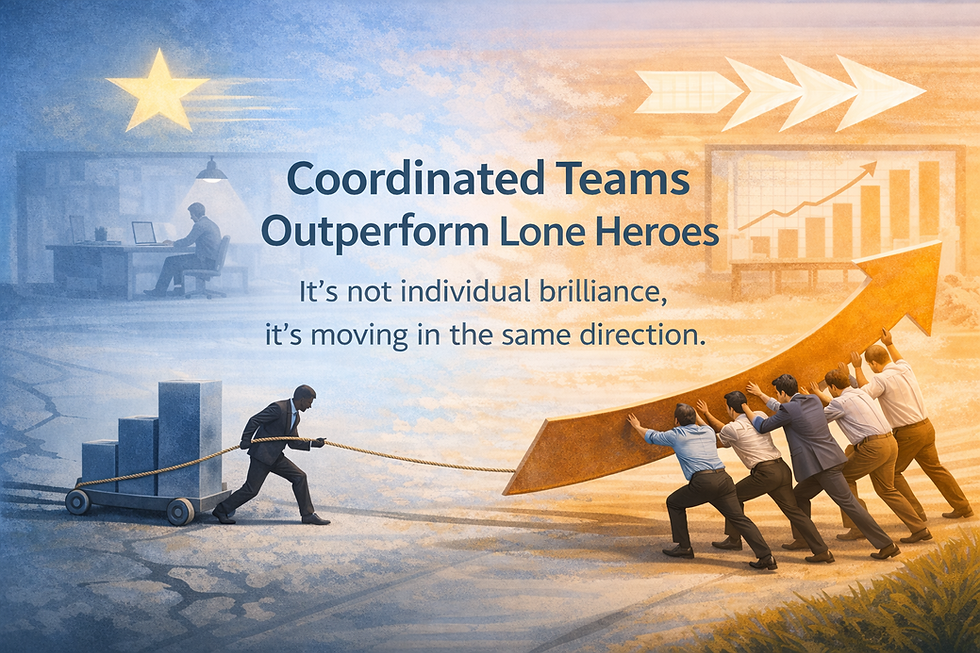
Talent doesn’t scale without coordination
Research on team effectiveness consistently shows that leaders influence performance less through direct control and more by shaping enabling conditions. Clear direction, stable structures, supportive context, and access to coaching matter more than heroic effort ([Hackman, 2002]).
This challenges a common assumption in hiring and performance management: that raising the average quality of individuals automatically raises team performance. In reality, when work is interdependent, coordination costs determine results.
Collective intelligence beats individual brilliance
One of the strongest empirical findings in this area is collective intelligence. Woolley et al. (2010) found that a group’s performance across tasks is not well predicted by the IQ or seniority of its members. Instead, it correlates with factors such as social sensitivity and balanced participation.
In other words, teams become effective not because they contain the smartest people, but because information flows well, voices are heard, and timing is aligned.
Why “stars” can weaken teams
Highly talented individuals can unintentionally create system-level risks:
Others become dependent instead of capable
Norms erode (“they’re allowed to break the rules”)
Participation narrows
The system becomes fragile when one person leaves
Classic work on high-performance teams emphasizes shared purpose and mutual accountability over individual heroics ([Katzenbach & Smith, 1993]).
Coordination is a skill, and it’s trainable
The good news is that coordination is not a personality trait. It’s a capability. A large meta-analysis by Salas et al. (2008) shows that team training improves performance across contexts, especially when teams develop shared mental models and communication routines.
This means organizations don’t need perfect people. They need better systems.
What organizations can do differently?
A few small shifts create disproportionate impact:
Evaluate performance by system contribution, not just output
Clarify direction so teams can align without constant escalation
Protect equal participation in meetings and decision-making
Reward reliability, knowledge sharing, and clean handoffs
When small efforts compound in the same direction, the system moves.
A short note about my work
Many teams want to collaborate better but are held back by unclear expectations, misaligned incentives, and over-reliance on individual “stars.”In my work, I help leaders and professionals design coordination that actually scales—through clearer roles, stronger team dynamics, and practical execution. If you want a team that performs like a system rather than a collection of individuals, feel free to reach out.
References
Hackman, J. R. (2002). Leading teams: Setting the stage for great performances. Harvard Business School Press.
Katzenbach, J. R., & Smith, D. K. (1993). The wisdom of teams: Creating the high-performance organization. Harvard Business School Press.
Salas, E., DiazGranados, D., Klein, C., Burke, C. S., Stagl, K. C., Goodwin, G. F., & Halpin, S. M. (2008). Does team training improve team performance? A meta-analysis. Human Factors, 50(6), 903–933.
Woolley, A. W., Chabris, C. F., Pentland, A., Hashmi, N., & Malone, T. W. (2010). Evidence for a collective intelligence factor in the performance of human groups. Science, 330(6004), 686–688.


Comments