The Lemur and the Lamp: 5 Sources of Inspiration for LinkedIn Writing
- Or Bar Cohen
- Nov 10, 2025
- 3 min read

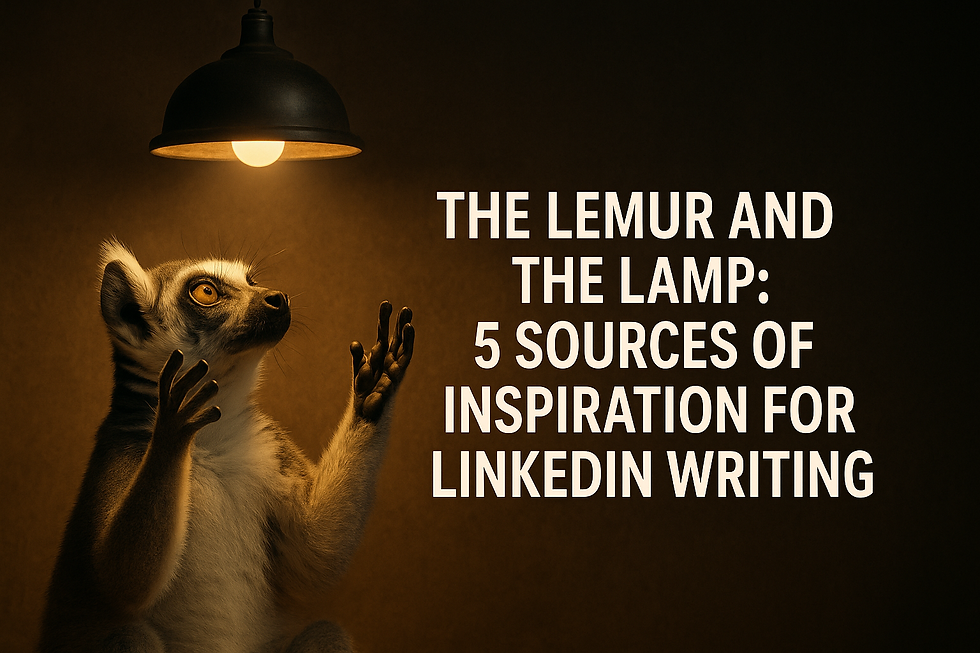
A short video caught my eye recently:a lemur sits quietly beneath a lamp.The light flickers on — and he raises his hands toward it, as if in reverence.
That tiny, instinctive gesture captures what inspiration truly is.It’s not something we chase. It’s something we notice.And that noticing — the ability to pause, reflect, and translate an emotion into language — is the essence of writing for LinkedIn.
Because meaningful content isn’t born from planning tools or algorithms.It starts with attention.
1. Everyday Life as Data
We often underestimate the insight hidden in the ordinary. A small workplace moment, a brief look, a single sentence can become a mirror of larger truths about leadership, growth, or humanity. Research indicates that reflecting on daily experiences enhances creative thinking and emotional connection (Kaufman & Gregoire, 2016).
When you learn to observe rather than scroll — content finds you.
2. Conversations as Mirrors
Ideas often arrive disguised as dialogue. A question from a client, a debate with a colleague, or even a comment you can’t shake off — all of these are entry points into perspective. Storytelling studies describe this as social inspiration: the process of shaping one’s thoughts through relational exchange (Bruner, 1990).
In other words, people spark ideas better than prompts ever will.
3. Failure as a Source of Trust
We tend to post our polished wins. But vulnerability — the willingness to show what didn’t work - is far more magnetic. Research on authentic leadership (Avolio & Gardner, 2005) indicates that self-disclosure enhances credibility and psychological safety.
When you share lessons instead of lectures, people lean in, rather than scrolling away.
4. Curiosity Across Fields
True inspiration rarely lives in echo chambers. Writers, artists, researchers, and leaders outside your niche can stretch your thinking in unexpected ways . Exposure to cross-disciplinary perspectives enhances originality and problem-solving (Maddux & Galinsky, 2009).
In short: the broader your input, the sharper your voice.
5. Silence as Space
Inspiration doesn’t always arrive as a spark - sometimes it’s a whisper. Cognitive research links creativity to periods of incubation and rest (Sio & Ormerod, 2009). When you allow stillness, connections form naturally.
Pausing is not procrastination - it’s composition.
Turning Light into Language
The lemur didn’t “try” to find inspiration; he responded to light. That’s what creative professionals do: they react to the world with awareness, not automation.
LinkedIn isn’t a platform for perfection. It’s a place for resonance, where you can show your thinking, process, and the light that moves you.
If you’re ready to refine that voice - to build a personal presence that feels natural, strategic, and authentic - that’s exactly what I help professionals and leaders do.
Let’s find your light together.👉 Contact me
References
Avolio, B. J., & Gardner, W. L. (2005). Authentic leadership development: Getting to the root of positive forms of leadership. The Leadership Quarterly, 16(3), 315–338.
Bruner, J. (1990). Acts of Meaning. Harvard University Press.
Kaufman, S. B., & Gregoire, C. (2016). Wired to Create: Unraveling the Mysteries of the Creative Mind.
TarcherPerigee.Maddux, W. W., & Galinsky, A. D. (2009). Cultural borders and mental barriers: The relationship between living abroad and creativity. Journal of Personality and Social Psychology, 96(5), 1047–1061.
Sio, U. N., & Ormerod, T. C. (2009). Does incubation enhance problem solving? A meta-analytic review. Psychological Bulletin, 135(1), 94–120.


Comments